

Ford Motor Co. is an example of the MT (Machine Translation) imperative on a grand scale. Ford has manufacturing facilities in Germany, Spain, Belgium, Mexico, and Brazil, where workers assemble vehicles using instructions in their local language. However, all of the instructions are originally created in the United States in English. A single car line can have assembly instructions with as many as 300,000 sentences. Moreover, the instructions undergo frequent changes during the production cycle, requiring quick retranslation and distribution. For such a massive translation problem, MT is the only viable solution.

Ford engineers prepare the assembly instructions using a standardized language. This language has a limited range of syntactic patterns and vocabulary to reduce the possibility of ambiguity. When assembly instructions are prepared, each standard language sentence is stored as a record in an Oracle database. Ford developed its own artificial intelligence system to check the sentences for conformity to the Standard Language rules. When Ford needs to translate the instructions for a particular vehicle and language, the appropriate records are sent to the SYSTRAN MT system, where they are translated using Ford's customized dictionaries and rewritten to the database. The translated instructions can then be sent directly to the PCs of Ford workers at manufacturing sites worldwide. Currently, Ford is producing MTs in four languages: German, Dutch, Spanish, and Brazilian Portuguese. The database, SYSTRAN system, and customized dictionaries are integrated into Ford's Global Study Process Allocation Process (GSPAS), a system for managing labor and manufacturing costs for Ford plants worldwide.

The difficulty of measuring the quality of automatic language translation systems (known as "machine translation" [MT]) has been an obstacle to widespread adoption. With systematic benchmark testing, categorization of errors, and effective dictionary customization, MT technology can yield significant cost and time savings, as well as improved consistency in translations. IDC makes the following observations about the MT market:

  • MT quality must be assessed in the context of each user's application. For example, using MT for a chat or instant messaging application is completely different from using MT to translate manufacturing assembly instructions
  • SYSTRAN has evolved a process for enhancing MT quality for an individual customer. This process has been validated with actual customers, such as Ford Motor
  • SYSTRAN has also developed the SYSTRAN Review Manager (SRM), which helps the customer to manage the MT quality process by allowing them to change vocabulary and linguistic rules. This tool represents an important advance in MT, both technologically and philosophically. Users have never before had the power to modify linguistic rules through an intuitive, interactive process
  • By opening up rule modification, SYSTRAN takes a risk, but one that will almost certainly pay off. Engaging users in the process of improving MT is the surest path to increased acceptance and understanding of the technology

In this study

In this IDC study, we discuss the efforts of SYSTRAN to address the issue of machine translation (MT) quality. MT technology faces several important obstacles to broader use in business applications. Most important among them is the issue of quality. Potential users perceive MT quality as uncertain and difficult to improve. All MT implementations require customization, and the scope of this task can be difficult to quantify. Such uncertainties can make ROI calculation difficult or impossible. But despite the perceived intangibility of MT, translation results can be measured and managed effectively. The key is targeted customization of the MT system, with ongoing benchmark testing to ensure that results continue to meet the customer's needs.

To address the quality impasse, SYSTRAN has developed the SYSTRAN Review Manager (SRM), a suite of quality management tools that address the measurement, testing, and customization tasks from a single user-friendly interface. Deployed successfully at Ford Motor Co., the SRM shows us the way to make MT quantifiable and viable for enterprise applications.

situation overview

Intorduction

Despite the growing business imperative to produce and use multilingual business materials, automatic translation technology (known as MT) faces many obstacles to widespread adoption. Three of the most important are:

  • Determining return on investment (ROI). There is currently no reliable method for calculating ROI. A useful formula for determining ROI would have to account for a broad range of factors, including language pairs, turnaround time, integration with existing applications, volume, customization, and support
  • Evaluation challenges. Translation technology is unfamiliar to most businesses. Comparing among competing products is difficult because it requires substantial knowledge of language technologies as well as a clear understanding of the specific translation requirements. MT products are completely nonstandardized, making feature comparisons difficult and further complicating the difficulty of evaluation
  • Uncertainty about quality. The difficulty of assessing and improving translation quality is MT's most intractable problem. Translation quality is inherently subjective and therefore difficult to measure. This is also true of human translation. A text given to three different professional translators will yield three different results. Even if all three are of high quality and accuracy, the subjective nature of human language almost guarantees that there will be differences in interpretation, word choice, and style. It can also be difficult to quantify the effort required to improve translation quality. Tracking ongoing quality levels is also a challenge
The MT Quality Impasse

There is an enduring perception that MT is not yet "good enough" for commercial use. The irony is that MT is better today than it ever has been, and it is in broader use. For many high-volume translation applications, the quality of translation is sufficient to allow understanding of the text. In addition, some MT systems, notably SYSTRAN, have introduced powerful linguistic and integration tools that have increased the user's ability to customize the MT system.

Still, the problem of assuring and measuring MT quality remains a serious concern among potential users. Many of these concerns are well founded, because it is difficult to track and quantify MT quality. There are a variety of factors at the root of the difficulty, which are discussed in the following sections.

Machine Translation Output Is Not Easily Predictable

MT systems work with natural language - a data set that is infinitely varying, ambiguous, and structurally complex. To translate adequately, an MT system must encode knowledge of hundreds of syntactic patterns, variations, and exceptions, as well as relationships among these patterns. It must include ever-changing vocabulary and specific semantic knowledge about the usage patterns of tens of thousands of words. It must accurately identify the parts of speech and grammatical characteristics of words which may, in different contexts, be nouns, verbs, or adjectives, each having many possible translations. Translation also requires a vast store of knowledge about the world, the intent of the communication, and the subject matter.

A human translator prioritizes and selectively applies linguistic rules based on this knowledge. MT software, unless explicitly coded for each possibility, cannot. Thus, MT will never attain the overall quality of human translation. The primary advantages of MT over human translation are speed, cost, and consistency. An MT system gets a great deal more translation done than is possible manually, and MT can deliver translations instantly for time-sensitive content. When a term is entered in an MT dictionary, it will translate it the same way every time, unlike human translators who may choose different translations at different times.

Quality Metrics Depend on the Input Text and the Level of Customization

Potential users want quality metrics that are objective, absolute, and easily compared among competing products. However, translation quality, whether human or software generated, is difficult to quantify. Counting the number of errors in a translated sentence is not revealing because languages do not correspond on a word-for-word basis. An incorrect analysis of one word in the source language, for example, could lead to incorrect translation of several words in the target language. In addition, many errors made by MT systems cause subsequent errors within the sentence. Different systems, and for that matter, different human translators, can produce intelligible, accurate, but different translations of the same sentence. Therefore, for any input sentence, there is no single, ideal output sentence. Finally, some errors are more serious than others, so all errors should not be assigned the same importance.

No Standards Govern MT Systems

Despite the decades of research and development that went into today's MT systems, the industry is still immature. MT systems grew up in very different ways, with many originating with academic research projects or government-funded initiatives. As a result, there are no accepted standards for how MT systems store or process data or what results they produce. Without a standard to measure against, each system vendor is left to make their own claims, which are not directly comparable with the claims of competitors.

Evaluation Is Not Objective

One evaluator might rate a translation as intelligible, while another may not. The judgment of translation understandability is an inherently subjective task that can be affected by factors, including the evaluator's subject knowledge, language facility, reading comprehension, translation experience, and attentiveness.

A Successful Strategy for the MT Quality Impasse

Many potential users give up when faced with the challenges of evaluating, enhancing, and implementing MT. MT vendors recognize the risks, and most have responded by working to improve basic translation quality to increase acceptance. But for most applications, improved translations are not enough. Adopters of MT need comprehensive, easy-to-use tools for measuring the quality of their translations, enhancing dictionaries, and verifying the results. The tools must be accessible to nondevelopers who know the languages and the business terminology for their company. Among the handful of commercial MT systems available today, only SYSTRAN has tackled the quality issue effectively.

SYSTRAN is unarguably the best-known and most comprehensive MT system in the world, having been in continuous development for more than 35 years. SYSTRAN offers 36 language pairs and has the largest dictionaries of any MT system. The company has taken a pragmatic approach, developing a suite of quality measurement and enhancement tools that offer a far more concrete solution to the quality question than esoteric measures of improvements in basic translation quality.

The MT Quality Enhancement Process

Making an MT system work for a particular application is a process, not a quick fix. Improving MT is a cyclic process beginning with review of a translation, update of dictionaries and other linguistic resources, and retranslation to validate the effects. In the SYSTRAN system, the SRM acts as a coordinator, managing access to different customization resources and tracking quality.
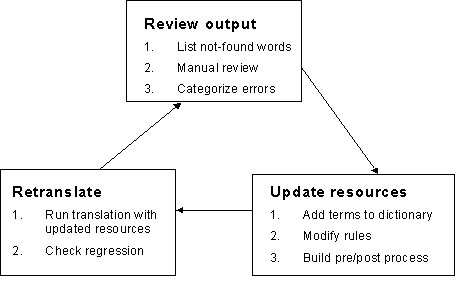
Figure 1 - MT QUALITY ENHANCEMENT PROCESS

Source: IDC, 2003

With potentially thousands of dictionary changes, numerous rule modifications, and changing text, it is a challenge to track customization activities and measure results.

The SRM integrates the three steps into a single-process management program with links to the user dictionary, the source and target texts, benchmark files, and interactive translation testing. In addition, the SRM categorizes errors, assigns levels of severity, and keeps track of statistics on the rates of various error types. It can be configured as a Web-based application for single or multiple users. In the latter case, reviewers in different locations can access translations, provide feedback, update dictionaries, and even store their own variant translations for a particular word or phrase. For multinational companies, the SRM allows easy cooperation between sites where different language abilities reside. Some additional benefits of the SRM are:

  • Demonstrable method of quantifying MT results
  • Increased user autonomy in the enhancement process
  • Reduction in the need for continuing customization services from a specialized provider
  • Leveraging of the company's own multilingual resources regardless of location
  • Increased QA productivity and deeper user engagement in the quality review process
  • Improved efficiency in managing translation projects

Step 1: Review Output Using the SRM

During this phase, the SRM functions as an interactive editor, presenting the reviewer with each translation unit in the translated text. The user can modify the translation if it is not acceptable. These modifications are recorded as new entries in the User Dictionary. In the soon-to-be-released version 5.0, the SRM can automatically determine grammatical information, such as part-of-speech and inflection patterns, and enter that information into the new dictionary record for the term or phrase. This function is known as "Intuitive Coding." With Intuitive Coding, people with language and subject knowledge can encode the dictionary without any special expertise in linguistics or programming. The reviewer can also view listings of words that were found in the text, but have not yet been entered in the dictionary. These listings can be entered directly into the User Dictionary from the SRM. The reviewer supplies the translation, and the Intuitive Coding functionality supplies grammatical information.

Step 2: Update Resources and Enhance Source Text

After the review process is complete, the dictionaries are saved, and the document can be retranslated. Reviewers can also open the dictionary records directly and modify or refine the translations or grammatical tags for an entry.

Enhancing the source text is equally important to dictionary building for quality assurance. Translation results tend to be better when the source text is modified to simplify word order and shorten lengthy sentences. SYSTRAN is developing an interactive linguistic tool that allows reviewers to modify the actual translation rules used by the translation engine. Combined with the SRM, the SYSTRAN Translation Workbench is an interactive XML-based editing tool that incorporates the reviewer's changes as rule modifications.

Once it is released, this tool will represent an important advance in MT, both technologically and philosophically. Users have never before had the power to modify linguistic rules through an intuitive, interactive process. Rule access was provided once before in the translation engine developed in the 1990s by Globalink. Code-named "Barcelona," that system was subsequently sold to Lernout & Hauspie and Bowne Global Solutions. The rule language of Barcelona, though powerful, was extremely complex, requiring a great deal of skill in linguistic notation, programming, and languages to use it effectively. In most MT systems, linguistic rules are not even accessible to the user because they are part of the source code.

Perhaps most importantly, the coming release of the SYSTRAN Translation Workbench represents a shift in the attitude of MT developers toward users. MT systems are extremely complex, and developers have always taken pains to protect the user from making naive changes to the system that could have serious consequences for other contexts. This attitude has been a source of frustration to more sophisticated MT users, who eventually reach a wall on quality improvements after building their dictionaries. By opening up rule modification, SYSTRAN takes a risk, but one that will almost certainly pay off. Engaging users in the process of improving MT is the surest path to increased acceptance and understanding of the technology.

Step 3: Retranslate and Validate

Once the changes to the system are saved, the reviewer can retranslate the text to verify that the new entries are in effect. It is important at this stage to check for regressions. Regressions occur commonly in MT output. They can sometimes originate with an incorrectly coded dictionary entry. For example, a user might supply a translation that is correct in the context of one sentence, but incorrect in another context.

The SRM manages regressions with a color-coding system that shows what portions of the text have changed since the last time it was translated. This feature reduces the amount of time spent on reading and comparing the previous translation with the new version by highlighting the areas for focus.

Significance of the SRM

The SRM will benefit SYSTRAN's customers by improving their understanding of translation quality and the process for improving it. The SRM also has broader importance, in that it places far more control over the translation process in the hands of the user than ever before. This may spur changes to the way the MT industry and its customers view each other and lead to more successful implementations of MT.

Case Study: SYSTRAN and Ford Motor

Ford Motor Co. is an example of the MT imperative on a grand scale. Ford has manufacturing facilities in Germany, Spain, Belgium, Mexico, and Brazil, where workers assemble vehicles using instructions in their local language. However, all of the instructions are originally created in the United States in English. A single car line can have assembly instructions with as many as 300,000 sentences. Moreover, the instructions undergo frequent changes during the production cycle, requiring quick retranslation and distribution. For such a massive translation problem, MT is the only viable solution.

Ford engineers prepare the assembly instructions using a standardized language. This language has a limited range of syntactic patterns and vocabulary to reduce the possibility of ambiguity. When assembly instructions are prepared, each standard language sentence is stored as a record in an Oracle database. Ford developed its own artificial intelligence system to check the sentences for conformity to the Standard Language rules. When Ford needs to translate the instructions for a particular vehicle and language, the appropriate records are sent to the SYSTRAN MT system, where they are translated using Ford's customized dictionaries and rewritten to the database. The translated instructions can then be sent directly to the PCs of Ford workers at manufacturing sites worldwide. Currently, Ford is producing MTs in four languages: German, Dutch, Spanish, and Brazilian Portuguese. The database, SYSTRAN system, and customized dictionaries are integrated into Ford's Global Study Process Allocation Process (GSPAS), a system for managing labor and manufacturing costs for Ford plants worldwide.

Unique Challenges

Every MT implementation involves a unique set of customization challenges related to the nature of the text and the intended audience. At Ford, some of these challenges were:

  • The texts contain numerous long noun phrases (e.g., insulation assembly body pillar), which must be recorded in the Ford user dictionary to ensure an accurate translation
  • All Standard Language sentences are written in Imperative form. Declarative sentences are the most prevalent type in most English texts, so grammatical coverage of imperatives tends to be less robust
  • Standard Language uses modification rules that are different from the rules for English. Modifying words can be placed after a noun, instead of before it. For example, the phrase "body panel large" is allowable in Standard Language, even though it is grammatically incorrect in English
  • Ford uses a specialized vocabulary. Some of the vocabulary is common to automotive manufacturing in general, but some terms can be specific to the specific plant or manufacturing team. Standard language contains 2,500 Ford-specific terms, 13,000 noun phrases, and over 1,000 abbreviations and acronyms. Ford uses an artificial intelligence system to review its assembly instructions and ensure they conform to the Standard Language rules
  • Spelling variants are common. The acronym for "antilock brakes" may be written as either ABS or A.B.S
  • Writers can insert free-form comments that do not conform to the Standard Language rules
  • Ford's bilingual engineers do not have the time to review translation results
  • Standard Language is usually written with no punctuation. MT systems are sentence based, and they rely on proper punctuation to help segment sentences, clauses, and lists
  • Standard Language is always evolving. The MT system and its dictionaries need updating to account for the changes in Standard Language
MT Integration at Ford

Ford and SYSTRAN collaborated successfully to address these challenges, integrating SYSTRAN into the GSPAS system in 1998. Today, the system is in use at Ford's worldwide manufacturing plants.

SYSTRAN analyzed Ford's texts to identify frequently occurring technical terminology and built a custom dictionary for the application. It was also necessary to map abbreviations to full words (e.g., [ASSY - ASSEMBLY]). SYSTRAN modified its translation system to account for modifiers that occur after the noun. Dictionary development is only one part of linguistic customization. To customize the rules of the translation system, SYSTRAN uses an XML-based "style sheet" that allows users to select from configurable rule categories. The categories of errors can be tabulated after the review is complete, offering insight into the nature and frequency of problems in the translation.

After initial tests, it was clear that some preprocessing of the assembly instructions would help translation quality, especially with embedded free-form comments and titles, neither of which conform to the Standard Language syntax. In addition, inserting articles (e.g., the) before nouns would help the MT system to identify the correct part of speech. For some languages, these problems are being addressed by automatically preprocessing the text prior to translation.

Ford also identified dialect and text size differences as important areas for quality enhancement. Many languages have variant dialects, though the differences in speech are usually far more extensive than in written English. For example, a coastal Maine resident and someone from the deep South might have difficulty understanding each other's speech. But in written form, their language is very much the same. The same principle applies with translation. In Spanish especially, there are numerous dialects. Although the differences are more prominent in speech than in writing, there are nonetheless some terminology issues among Spanish dialects. The quantity of text for any given message varies depending on the languages involved. For English to Spanish translation, for example, translations are generally 15-20% longer in Spanish than in English. This has implications for how the text is displayed and the size of the text window in the user's application.

Future Outlook

The use of SYSTRAN has helped Ford to translate its large volumes of assembly instructions into four languages. More than 1 million records have been translated. Ford has been able to deliver an accuracy rate of 90% for English/German translations. Ford deployed a Web-based customer dictionary tool in 2002 that allows engineers to introduce new dictionary entries and corrections to translation errors. Modifications to the Standard Language have been introduced as a result of translation feedback.

Essential Guidance

The MT quality impasse can be overcome with customization, ongoing error tracking, and testing against benchmark files. This process can be intimidating to new users who are unfamiliar with MT technology. To deploy MT successfully, the vendors must provide guidance and support to the user until sufficient knowledge is built up within the organization to manage translation quality independently.

When it is effectively customized and tested, MT does produce cost and time savings. Ridding potential users of the notion that MT is a "plug and play" solution is perhaps the MT industry's most important educational objective. The SYSTRAN implementation at Ford Motor provides an excellent case study of how MT, when properly customized, can solve a critical, large-scale translation problem. Other MT users and vendors would do well to follow Ford's example.

Learn more

  • Machine Translation Engines: An Evaluation of Output Quality (IDC # 22722 , June 2000)
  • MT and TM: ESTeam's Winning Solution (IDC # 28367 , November 2002)
  • Worldwide Globalization/Translation Software Market, 2002 (IDC # 28166 , November 2002)
  • SYSTRAN and the Reinvention of MT (IDC # 26459 , January 2002)

TRANSLATION SOFTWARE - CASE STUDIES / ACTUAL CUSTOMER TESTIMONIES

Symantec is a global leader in infrastructure software, enabling businesses and consumers to have confidence in a connected world. The company helps customers protect their infrastructure, information, and interactions by delivering software and services that address risks to security, availability, compliance, and performance. Headquartered in Cupertino, California, Symantec has operations in 40 countries.

Within Idiom WorldServer, the Fuzzy Score is set here to 75%. SYSTRAN automatically translates segments lower than this threshold. Translators review coloured segments within the Browser Workbench.

« Our main objective is to offer quality product documentation and technical support to our international customers in a cost effective manner. With the roll-out of our global content management system, we have control over our documentation production process. Our metrics show a 100% increase in word counts managed by our internal translation team since the introduction of SYSTRAN technologies into our localization process. Automated translation software is a powerful innovation when integrated into a streamlined translation workflow. It clearly boosts our globalization capacities. »

Fred Hollowood & Orla Clifford,
Global Language Services, Symantec.

Challenges Solutions Results
  • International customers to service with a variety of content and formats
  • Product documentation published in 20+ languages
  • Technical Support content delivered in multiple languages
  • To help and support international customers in their own languages
  • Integrate SYSTRAN Translation Technology with an online global content management workflow system
  • Automatically translate with SYSTRAN no match segments in translation memories
  • Product Documentation and Technical Support content in English, translated in French, German and Japanese
  • Chinese, Spanish and Italian localisation as a second step
  • Personal productivity for internal translation team doubled
  • A cost effective solution which makes it possible to increase volume of translated content
  • Address translation projects with scalability and cost control
  • Control terminology and streamline methodology to smoothly enable new language pairs


What are the main reasons that invoked your interest in machine translation for use within your Global Language Services department?

Symantec operates in more than 40 countries. As a leader in IT infrastructure, we deliver sophisticated products and services to international customers. As an international company, we focus on globalization early in the process. Our Global Language Services division addresses the needs of localized product documentation and technical support content. With multiple acquisitions completed in the last number of years, Symantec’s globalization requirements are complex and diverse. Faced with these increasing needs, we chose to evaluate a rapid, cost-effective translation technology. Our goal is to reduce translation costs to 35% and reduce translation time by 66%, while maintaining quality standards.

What are the main reasons that invoked your interest in machine translation for use within your Global Language Services department?

Symantec operates in more than 40 countries. As a leader in IT infrastructure, we deliver sophisticated products and services to international customers. As an international company, we focus on globalization early in the process. Our Global Language Services division addresses the needs of localized product documentation and technical support content. With multiple acquisitions completed in the last number of years, Symantec’s globalization requirements are complex and diverse. Faced with these increasing needs, we chose to evaluate a rapid, cost-effective translation technology. Our goal is to reduce translation costs to 35% and reduce translation time by 66%, while maintaining quality standards.

Can you describe the first steps of your machine translation project?

We started this project by integrating SYSTRAN technology with Trados Translation Memory technology. Our internal linguistic teams quickly gained confidence in maintaining customer specific dictionaries and post editing. Indeed they doubled their personal throughput of translation content provision over the first six months of the project. After this initial success, we integrated MT with Idiom’s WorldServer system and applied this model to all of our workflow enabled translation resources.

How did you choose SYSTRAN among the other competitors?

We chose SYSTRAN from among a range of MT technology suppliers for the following reasons:

  1. They provided a comprehensive language spread for global deployment .
  2. The rules based approach allowed us to begin translation without significant engine training
  3. Their client-server based solution allowed centralisation of customer specific dictionaries in addition to general scalability.
  4. The robust well documented API allows us to integrate this technology with other third party language technology tools.
  5. The customisability of the solution has allowed us to quickly tailor the technology and process to our various requirements.

Can you describe your customised solution for product documentation?

The basic idea is to use machine translation in tandem with a computer-aided translation tool. We never intended to ‘replace’human translation but instead wanted to assist professional translators with innovative tools. We developed an application to link machine translation processes between SYSTRAN and Trados. We called it SymGlue (i.e. Symantec Global Language User Environment).

In short the process leverages existing translations from Trados TM’s and then exports lower value or no match segments to a TMX file.

We then pass this file to SYSTRAN for machine translation and finally re-import the machine translated TMX file back into the Product Translation Memory. We have used this process on a variety of content including Product Documentation and Technical Support in a variety of languages, specifically Japanese, Simplified Chinese, French, German, Italian and Spanish. Underpinning this solution is a robust and well embedded practice among our Infodev writers of authoring content in a controlled way. We have deployed controlled language checking software (acrocheck) to help our writing teams in this practice.

What were your results once you introduced machine translation into your translation process?
In a very short time, the throughput of our internal translation team doubled from an average translation throughput of 1500 words per day to 3000 words. When applying this process to larger documentation sets we have aimed and achieved an increase in throughput of up to 60% in some languages.

With the roll-out of Idiom WorldServer in 2009 and the SYSTRAN integration with same, we expect to further increase our productivity. The integration of SYSTRAN and Idiom WorldServer give us a completely automated translation process. We gain control on delivery timing and have the potential to deliver ever increasing amounts of previously untranslated content.

How do SYSTRAN and Idiom WorldServer work together?

Both companies have extensive API’s which facilitated their integration in our process. Future innovations in the development of both products will allow for an ever tighter, more seamless integration.

What are the points you appreciate in SYSTRAN translation technology?

Apart the overall good translation quality for the off-the-shelf engine, we appreciate the powerful customization capabilities within the SYSTRAN modules. With SYSTRAN Translation Style Sheets, we were able to manage Framemaker and XML specific tags within the product documentation content, neutralising the potential issue that they present to a MT engine. We are now starting to use this XML-aware technology to provide context sensitive translation based on XML tags or Framemaker elements. We are also interested by the new metrics proposed in SYSTRAN version 6, in particular the complexity and the confidence scores to have more control on the translation reliability and accuracy.


Military, Defense, Technical  TranslationEADS is a global leader in aerospace, defence and related services. The Group includes the aircraft manufacturer Airbus, Eurocopter, the world's largest helicopter supplier, EADS Astrium, the European leader in space programmes from Ariane to Galileo and MBDA, the international leader in missile systems. EADS largely deployed SYSTRAN on its Intranet. MBDA ensures the continuous enrichment of the translation tool.

"The dictionary coding at the heart of machine translation removes ambiguities so at MBDA, we load a number of noun phrases and verb phrases into SYSTRAN to maximize the coverage rate and enhance translation quality. The higher quantity of expressions contained in the user dictionaries leads to improved translations. The various terms and phrases are initially created by MBDA and then transferred to the SYSTRAN Translation Server on the EADS portal, which is accessible by all EADS users. Even basic machine translations are now of a good quality, meaning the number of requests for expensive human translation services have been reduced. Users are increasingly going to the self-service portal."

Michael Hoff and Eliane Grosheny-Langlois,
Translation Department, MBDA.

Challenges Solutions Results
  • Improve communication and knowledge share between EADS sites located in the UK, France, Spain, Italy and Germany.
  • Cover all languages spoken within the organisations, including English, French and German at first, then Italian and Spanish as a second phase.
  • Reduce requests for human translation, and associated costs.
  • Assist organisational changes and enable employees to work in a multilingual environment.
  • SYSTRAN Enterprise Server installed within the firewall provides a translation service inside the EADS portal.
  • MBDA Translation Department builds large dictionaries in defence, aerospace, engineering, management and legal from translation samples and by using terminology extraction tools.
  • MBDA Translation Department offers machine translations combined with a quick post-edition as a free-of-charge service which provides enhanced translations against inhouse requests.
  • High level translation quality with an out-of-the box EADS translator obtained from customised dictionaries.
  • Strong, and increasing, use of translation requests inside the EADS ESIS portal - with more than 30,000 translations per day.
  • Direct cost savings of 30% of the yearly budget on human translation services at MBDA; combined with advantages of a close-to-real-time service.

A few minutes with the MBDA Translation Department…

With an integrated framework covering France, the UK, Italy and Germany, MBDA is ideally positioned to offer tailored defence systems that address the requirements of its defence and domestic customers in Europe. Now, with employees working across all these countries, MBDA is facing an increased need to knowledge-share. Tools are required to enhance collaboration between entities and to reduce language barriers between the employee base.

MBDA must handle effectively a high level of translation requests from engineering, management, product development, quality and legal departments so started to look for, and assess, machine translation solutions as an innovative initiative under the sponsorship of the EADS Group.

The project originally started in 1999 with MBDA acting as the project leader and main provider of terminology for customisation. EADS then performed a direct comparison between two language translation technologies. At that time, SYSTRAN - available in version 3 –boasted the higher level of translation quality and was therefore the solution that was chosen.

The basic idea was to create an overall translation service shared by all entities within the EADS Group. Three language pairs were selected: French-English, German-English and German-French.

During 2000 and 2001, the project team spent most of its time collecting various terms from many different entities. MBDA played a central role in gathering all vocabularies, restructuring them and loading them into the machine translation system.

EADS and MBDA then undertook a major campaign to adapt the terminologies to suit the other translation software which was then in use. "It was painful because using the other translation software meant we had to manually code all inflections of each term."

At that time, the machine translation service was then made available to end users through a single page on the EADS Intranet. The service became popular very quickly, so in 2001, costs of terminology integration started to become more and more important.

At that time, Michael Hoff produced an average of 120 entries per day, integrating them into the dictionaries of the translation software then in use. To increase the integration flow, EADS/MBDA started to subcontract additional professional services but the model was not scalable and became expensive as the requirement was to integrate more terms and expressions into the system.

During 2003, pushed by EADS growth and the integration of entities, the company wanted to extend the system and add Italian. At the same time, SYSTRAN released its new version product which featured Italian language pairs with both English and French.

Following a re-assessment of SYSTRAN, the company then decided to implement SYSTRAN as the preferred EADS Translation Server solution.

According to Michael Hoff "The IntuitiveCoding technology enabled a large increase in productivity. At the end of 2003, we had a backlog of around 100,000 terms to be coded. With the old translation software, this task was impossible to complete. With SYSTRAN and its Dictionary Manager functionality, we loaded the data within a few weeks."

Compelling business reasons to use machine translations are low costs and quick results. Often, users have time constraints and need to translate a large volume of text quickly: such as operational documents, design specifications, engineering documents, quality plans, meeting minutes, good manufacturing practices, management documents, etc.

In early 2004, the MBDA Translation Department (at that time part of the Quality Directorate) decided to begin work on French-English machine translation on a wide scale through bulk integration of the terminology along with the corresponding validation work in corpus documents. At this time, the EADS level of activity was at approximately 30,000 translations per day.

On the EADS translation server, English to French is the most popular language pair (31%), followed by English to German (22%) then French to English (19%) and German to English (14%).

Along with the EADS translation service portal page, an email-based user comment service was also developed. This service saw a further increase in quality using a dialogue method across the users - taking their remarks into account and thus providing the human element of the process.

The MBDA Translation Department also then noticed that comments subsequently started to decrease, whilst the number of users and translation requests increased.

In addition to this successful translation service portal initiative, MBDA was also working to reduce the costs of human translations.

The MBDA Translation Department completed more than 10,000 translation requests in 10 years with its classic human-based professional translation service. To address these translation demands, MBDA had defined an intermediate state which was called "enhanced machine translation". It offered to quickly post-edit the output of SYSTRAN translation and produce a translation quality that was close to professional translation.

The mission of the MBDA Translation Department now is to provide all kind of translations - offering three classes: classic-professional translations done by humans, machine translations performed using computer technologies, and enhanced machine translations performed by machine translation software with minimal human post-editing.

"The three types of translations fit perfectly with all the translation needs that we are faced with inside our organisation," Hoff added. "Around 1,000 human translation requests were addressed to the department last year, 20% of which were processed using the new enhanced workflow which reduces the overall demand for expensive human interactions. Between 2004 and 2009, we saved around 30% of our yearly budget, thanks to the new service.

The SYSTRAN system was customised with large EADS and MBDA dictionaries to offer the capability of producing a translation that was up to 90% complete. Revisions then only took a few minutes per page.

Quality output is mainly dependant on the effectiveness of the user dictionaries," Hoff concluded.

An ideal machine translation solution would feature complete disambiguation of all ambiguous categories (semantic and context) in the source document.

To obtain the quality approach, the translation solution creates dictionaries that contain as many noun collocations, multi-purpose expressions and verb phrases as possible.

"The dictionary coding at the heart of the translation machine removes ambiguities so at MBDA, we load a number of noun phrases and verb phrases into SYSTRAN to enhance translation quality. The higher quantity of expressions contained in the user dictionaries leads to improved translations."

SYSTRAN offered a key advantage against the previous translation software - IntuitiveCoding technology. SYSTRAN automatically codes all inflections for a given term and, in addition, offers a very powerful coding technique that enables context-specific translations of the terms used.

MBDA is now using specific tools to automatically extract the expression candidates from the texts. Then decides whether to code them or not within the dictionaries.

Thanks to the SYSTRAN dictionary prioritisation sequence - which is formed by subsequent layers of dictionaries - the most recent term additions are used before older terms. Effectively, the system evolves to produce increased quality translations.

The architecture is also error tolerant as errors can be corrected in the uppermost dictionary without requiring corrections in the lower layers. It also reduces the workload for ensuring the system remains operational.

At present, SYSTRAN handles more than 300,000 terms within the user dictionaries which are organised in six user domains: Aerospace, Defence, Information Technology, Legal & Business and Optronics. These customised resources are then periodically transferred to EADS to also enhance the translation services on the Intranet portal.

With a highly customized translation system, EADS portal users can now easily select from a list the right user domain, and then enter the text or upload a document for translation. Supported formats are DOC, PDF, TXT, RTF and HTML.

Usage rate is also growing, demonstrating that it is a useful business tool that can empower companies to reduce language barriers throughout their organizations.

Typical impact density of EADS / MBDA user dictionary terms in a machine translation (without any manual post-editing)

Communiqué de Presse MBDA (mai 2009) MBDA press release (may 2009)
ASTER ASTER
De l'autoprotection à la défense anti- missiles balistiques From self-protection to anti-ballistic missile defence
Le programme Aster est le fruit des analyses opérationnelles et techniques menées par la France et confortées par les études de l'OTAN, puis de la coopération étroite et volontariste de la France, l'Italie et le Royaume-Uni, pour se doter d'une famille de systèmes anti-aérien et anti-missile terrestre et naval. Ainsi, six armées de trois pays européens financent le développement de variantes navales (Aster 15 et Aster 30) et terrestre (Aster 30) de moyenne portée. Au plan industriel, Aster est aussi un programme structurant de l'industrie européenne de défense avec plus de 1700 missiles déjà commandés. The Aster programme is the fruit of the operational and technical analyses carried out by France and consolidated by the NATO studies, then of the close and voluntarist co-operation of France, Italy and the United Kingdom, to procure of a family of ground-based and naval anti-aircraft and anti-missile systems. Thus, six armies of three European countries finance the development of naval variants (Aster 15 and Aster 30) and land (Aster 30) medium-range. At industry level, Aster is also a structuring programme of the European defence industry with more than 1700 missiles already ordered.
Les systèmes à base d'Aster bénéficient de la technologie la plus aboutie pour traiter les différentes menaces et notamment la menace balistique de courte portée. Anti-missile de conception, les choix technologiques lui confèrent une très grande manœuvrabilité et une très grande agilité ce qui lui permet d'intercepter dans la majorité des cas par impact direct des cibles avec des vitesses de rapprochement de l'ordre de 4000 km/heure. The Aster-based systems profit from the cutting-edge technology to treat the various threats and in particular the short-range ballistic threat. Anti-missile by design, the technological choices confer a very great manoeuvrability and very an high agility to him what enables him to intercept in most cases by direct hit of the targets with closing velocities of about 4000 km/h.
La manœuvrabilité d'un vecteur étant inversement proportionnelle à son poids, Aster est donc aussi petit et léger que possible. La conséquence directe a été d'aboutir à une dichotomie entre le volume d'interception, dépendant de la propulsion principale et l'efficacité à l'intérieur de ce volume. L'Aster est donc placé dans son domaine d'interception par un accélérateur largable, dimensionné en fonction des besoins opérationnels. Pour satisfaire à l'exigence de couverture sur 360° dans une fenêtre de tir réduite et avec des portées d'interception courtes, le lancement de l'Aster est vertical et les tuyères de son accélérateur sont flexibles. Elles sont dérivées des technologies spatiales (Ariane). The manoeuvrability of a vector being inversely proportionate with its weight, Aster is thus as small and light as possible. The direct consequence was to lead to a dichotomy between the interception envelope, depend on the main propulsion and the effectiveness inside this volume. The Aster is thus placed in its interception envelope by a jettisonable booster, dimensioned according to the operational requirements. To meet the requirement of 360° coverage in a reduced firing window and with short interception ranges, the launch of the Aster is vertical and the nozzles of its booster are flexible. They are derived from space technologies (ARIANE).
Le choix d'un pilotage aérodynamique fort conjugué à un pilotage pyrotechnique additionnel appliqué au centre de gravité du missile intercepteur compensant le temps de réponse du pilotage aérodynamique a permis de concevoir un vecteur à l'agilité et à la manœuvrabilité inégalées dans tout son domaine d'action et ce principalement à haute altitude, ce qui le distingue nettement de ses concurrents. The choice of a strong aerodynamic flight control combined to an additional pyrotechnical flight control applied to the centre-of-gravity of the intercepting missile compensating for the response time of the aerodynamic flight control made it possible to design a vector with the agility and the manoeuvrability unequalled in all its operation area and this mainly at high altitude, which clearly distinguishes it from its competitors.

MBDA and EADS dictionaries offer extensive coverage on any corporate text or document. As a consequence, SYSTRAN out-of-the-box translations are always of a high quality and require minimal, or no, revisions.


TESTIMONIAL BYTESTIMONIAL BY: James Mentele, Information Scientist with Dow Corning Corporation had these comments about Systran Software.

Accuracy - "Systran is superior to other translation systems that we have examined."

Overall Productivity - "In our experience, Systran is superior to other translation software. It is excellent for assimilation and can be a great aid to a less-than-fluent multilingual person. We believe that we will have a distinct competitive advantage if we can enable workers to produce work-products as fast, safely and accurately as possible (usually in the person's native tongue). but tie that activity into global projects and workflow for greatest leverage of impact."

Completeness - "Systran excels compared to other software tools that we have investigated - both in breadth of specialized dictionaries, as well as features like proper nouns (name) extraction, .nfw (not found word) file to highlight potential problems, romanji transliteration of English and katakana/hiragana of Japanese."

Cost Savings - "The seconds of machine time per page with Systran is dramatically less than the hours per page of a human translator. It doesn't take many pages to recover the cost of the PC and the Systran Software."

Manpower Savings - A major strategy of a global company is to achieve improved results with fewer people-hours by being able to leverage specialized skills and knowledge worldwide. Such a goal is not realistic without the ability to translate work products. Translations of such volumes and subject are not realistic without large numbers of multilingual domain experts. Systrans's specialized dictionaries greatly reduce the need for such rare capabilities. Our studies have shown that the time spent by employees translating reports in 1993 was equivalent to salary and benefits of the $6 million in Japan alone."

Time Savings - "The biggest time savings occurs for employees who must translate their work products (monthly reports, project status reports, etc.) into another language (primarily English) for management."


TESTIMONIAL BY TESTIMONIAL BY: The National Air Intelligence Center's 28-Year Relationship with SYSTRAN Software, Inc. A Case Study

Agency Description - The National Air Intelligence Center (NAIC) at Wright-Patterson Air Force Base, Ohio, is the Air Force's single all-source aerospace intelligence center. Its mission is to support the war fighter, the acquisition community and the national policy maker by acquiring, collecting, analyzing, producing and disseminating foreign aerospace intelligence to the U.S. Air Force, the unified commands, sister services, other members of the intelligence community and allies.

The NAIC was formed in 1993 by combining the Foreign Aerospace Science Technology Center, which focuses primarily on the production of scientific and technical intelligence, and the 480th Intelligence Group, which focuses on the preparation of cockpit-oriented target material and mission planning intelligence. In 1994 the 497th Intelligence Group Directorate of Assessments, which provides analysis support directly to the Air Staff and other intelligence organizations in the Washington, D.C. area, was integrated into NAIC. The consolidation of these three units resulted in a signification mission expansion enabling NAIC to provide fully integrated intelligence products tailored to customer requirements. The NAIC has a staff of approximately 1,700 people.

SYSTRAN's Involvement with the NAIC In 1968 SYSTRAN Software Inc. was contracted to develop Russian-to-English machine translation for the U.S. Air Force through a predecessor agency of NAIC. In 1969 the first SYSTRAN system was tested at Wright-Patterson Air Force Base. Since 1970, the system has continued to provide translations for the USAF's Foreign Technology Division. SYSTRAN was used by NASA during the joint US-USSR Apollo-Soyuz space project in 1974-75.

SYSTRAN translation software is used at more than 30 sites within the intelligence community. SYSTRAN's Russian-into-English machine translation program now includes more than a half million words and operates at more than 90 percent accuracy on technical texts.

Translation Needs - The National Air Intelligence Center has extensive translation requirements in terms of languages and documentation, although a description of translation requirements is not available.

Currently NAIC translates technical texts, foreign language journal articles, and systems documentation from nine languages into English using SYSTRAN Software. As part of its current five-year contract with NAIC, SYSTRAN will create machine translation systems for several Eastern European languages, including the first-ever Serbo-Croatian-into-English machine translation software program.

Translation Strategy - SYSTRAN Software is used organization-wide for quick information. It is used by the Translation Services Department for edited and finished translations.

NAIC has a government-wide unclassified network called "NAIC Open Source Information Service (NAIC OSIS)." This network uses nine SYSTRAN systems to translate text for Internet Websites submitted by government users. This is now being migrated to a secret network and to a top secret network called Interlink. As a result, SYSTRAN software is accessible on three different networks from NAIC's Home Page on the World Wide Web for use by the entire U.S. intelligence community.

Benefits of SYSTRAN Software - "The most heralded aspect of machine translation from user surveys over the past 15 years has been time savings." The agency also notes that "The most heralded aspect of machine translation from user surveys over the past 15 years has been time savings." The agency also notes that using SYSTRAN results in manpower savings, cost savings and an increase in overall productivity .


TESTIMONIAL BYTESTIMONIAL BY: Autodesk

Autodesk Chooses Systran for Multilingual Customer Support

Autodesk's Evaluation Process: Autodesk conducted an informal but comprehensive evaluation of MT products before selecting SYSTRAN for its application. A test suite of representative technical articles was provided to potential MT providers, and the results were reviewed by Autodesk's linguists and technical support staff. The review focused on identifying translation results that were useful and understandable, despite the stylistic and grammatical errors that MT systems inevitably produce.

Autodesk followed a software-development approach to evaluating SYSTRAN. Errors were reported back to the SYSTRAN team. SYSTRAN then fixed the errors and submitted revised versions of the system to Autodesk for verification that the changes had been made. This process allowed Autodesk to observe both the responsiveness of the SYSTRAN team and the enhancement potential of the technology.

Autodesk cited three factors in the selection of SYSTRAN from a field of competitors. The first was that SYSTRAN's output quality reached the threshold of intelligibility that Autodesk felt was needed to make its deployment successful. The AltaVista deployment of SYSTRAN for multilingual Web page browsing gave Autodesk confidence in SYSTRAN's scalability. Less tangible, but equally important, was the impression that SYSTRAN understood Autodesk's needs better than other providers and could work with Autodesk to tune the system to its unique texts.

SYSTRAN CEO Dimitris Sabatakakis also believes SYSTRAN's ongoing extensive development work was an important factor. The system is undergoing a major revamping of its dictionary structure that will allow it to leverage its enormous lexical resources more quickly and efficiently.

Autodesk's Multilingual Customer Support Application

The Company: Autodesk is the developer of AutoCAD, a computer-assisted design (CAD) software platform. Most of the company's applications for specific design requirements, such as architectural and mechanical design, multimedia, manufacturing, construction, and geographic information systems, rest on the AutoCAD platform. Autodesk products are used by more than 4 million design professionals. Based in San Rafael, California, Autodesk has offices in 60 other locations worldwide. John Walker founded the company in 1982. The company will have revenue of approximately $1 billion in 2001.

Business Rationale: With more than 60% of its business conducted outside the United States, Autodesk is a case study for the challenges of information dissemination and management in a multilingual environment. One of Autodesk's most pressing challenges is supporting customers across many languages in a cost-efficient manner. Autodesk provides customer support through a database of more than 10,000 articles that are accessible from its Web site. The articles, which average 1,000 words in length, are written in English only, are highly technical, and are specific to design issues for various industries.

Unlike the highly dynamic content in chat, email, and message boards that has been the focus of previous Internet MT applications, Autodesk's content is relatively stable. Once posted, the text of articles rarely changes, and only a few hundred new articles are added each month. The database receives an average of 500,000 hits per business day.

Although the percentage of hits that require translation is unknown, the potential volume of translation is very large given the size of the database and the number of users and languages. Frequently requested articles will be pretranslated and cached to allow instant delivery to customers and to reduce the load on the translation servers.

Autodesk acknowledges that without MT it would not be able to deliver multilingual customer support comparable to what it provides to English-speaking customers. Mirko Plitt, process analyst in Autodesk's Worldwide Localization department, states that SYSTRAN's "innovative customization approach was the only answer to our international customers' need for a multilingual product support knowledge base: translations produced by general-purpose MT systems are of little use to our non-English-speaking clients, and a translation workflow involving human intervention was not a realistic option. The specific machine translation solution developed by SYSTRAN maximizes the benefit our customers get from the Product Support Web site and further increases the quality of service provided by Autodesk.


TESTIMONIAL BY TESTIMONIAL BY:Fisher-Rosemount System, Inc.'s Experience With SYSTRAN Software, Inc. A Case Study

Company Description - - The Fisher-Rosemount family of companies is the world's largest process management supplier. Fisher-Rosemount not only leads in many global market segments, but it also has the industry's broadest process-automation offering, including process management systems, control valves, regulators, transmitters, analyzers and related services. Fisher-Rosemount, Inc., is a world-leading supplier of process management systems and services. The company, headquartered in Austin, Texas, maintains key manufacturing and technology centers in Burnsville, Minn.; La Habra, Calif.; Cambridge, Ontario (Canada); Leicester, England; and Singapore. Fisher-Rosemount Systems offers three process management systems, each of which reflects the company's long heritage as a pacesetter in process automation. The company, which was established in 1956 as Rosemount Inc., now has approximately 1,000 employees.

Translation Needs - Fisher-Rosemount Systems, Inc. has extensive translation requirements in terms of languages and documentation. Materials that need translation are sent to SYSTRAN Software, Inc. via E-mail, translated into final, edited copy at SYSTRAN's world headquarters in La Jolla, and returned electronically. Fisher-Rosemount requires translation of approximately 400 pages per year.

Translation Software Language Pairs: English German, French, Russian, Spanish, Chinese and Japanese. Types of Documentation: Customer manuals for both hardware and software product.

Translation Strategy - - The Fisher-Rosemount family of companies is the world's largest process management supplier. Fisher-Rosemount not only leads in many global market segments, but it also has the industry's broadest process-automation offering, including process management systems, control valves, regulators, transmitters, analyzers and related services. Fisher-Rosemount, Inc., is a world-leading supplier of process management systems and services. The company, headquartered in Austin, Texas, maintains key manufacturing and technology centers in Burnsville, Minn.; La Habra, Calif.; Cambridge, Ontario (Canada); Leicester, England; and Singapore. Fisher-Rosemount Systems offers three process management systems, each of which reflects the company's long heritage as a pacesetter in process automation. The company, which was established in 1956 as Rosemount Inc., now has approximately 1,000 employees.

Translation Needs - Fisher-Rosemount Systems, Inc. has extensive translation requirements in terms of languages and documentation. Materials that need translation are sent to SYSTRAN Software, Inc. via E-mail, translated into final, edited copy at SYSTRAN's world headquarters in La Jolla, and returned electronically. Fisher-Rosemount requires translation of approximately 400 pages per year.

Language Pairs: English German, French, Russian, Spanish, Chinese and Japanese. Types of Documentation: Customer manuals for both hardware and software product.

Translation Strategy - Previously, translation was handled in various foreign countries on an as-needed basis. In 1992 Fisher-Rosemount began relying on SYSTRAN for translations of technical manuals. The relationship has been effective because of SYSTRAN Software's "speed and cost."

Benefits of SYSTRAN Software Translation Services - "Having one source for translation regardless of the language is a great convenience.

SYSTRAN Software, Inc. is very strong in machine translation. The people we work with at SYSTRAN are very knowledgeable of computer-aided translation and the Interleaf program.

It's a great time-saver to receive the translated files electronically in the proper format. We receive excellent phone, fax and E-mail response to questions and problems. We are working with SYSTRAN to develop a methodology to minimize the costs of revisions within the translated documents. A weakness in the process is the absence of translation support for on-line help systems in Windows NT."


TESTIMONIAL BY TESTIMONIAL BY:Gaumont Newsreel Archives

SYSTRAN Chosen to Translate its French Online Newsreel Catalogue for the Global Marketplace

When Stuart McKay, a freelance film archive researcher, was looking for historical footage of the First World War for a new British TV series, he naturally turned to the Web for information about relevant holdings in French film archives. France, the birthplace of cinema, has a vast range of holdings of early film in its military and government archives. But what made Stuart's search particularly fruitful was the availability of a remarkable online database listing the complete historical footage held in the Cin�matique Gaumont newsreel archives. And above all, the ability to search this database in the universal language of professional media searchers - English.

The Cin�matique Gaumont is a French film library offering the largest range of French language newsreel and other film holdings of its kind. Information about the archive is accessible via the Internet, offering film researchers an unparalleled database for searching cultural and historical material on celluloid, viewing excerpts and then ordering them. To render this facility as universally accessible as possible to researchers like Stuart McKay, Gaumont contracted SYSTRAN to provide an ondemand translation solution that would enable researchers to retrieve the database and read its film descriptions in English. Gaumont has been able to substantially grow its market for newsreel film archive users by combining the ease of access afforded by an online database with the communicative effectiveness of SYSTRAN's Machine Translation technology.


TESTIMONIAL BY TESTIMONIAL BY: Price Waterhouse Cooper

Use and Cost Savings: Based on the success of an initial deployment in Spain, other countries were added one at a time by customizing the system for each new language and adding authenticated access for the users in that country. PwC paid for the service under a global agreement, with individual countries paying for the cost of local customization (that is, adding PwC-specific and department specific vocabulary to the generic translation dictionaries). List price for a machine translation desktop software license is approximately $1,000, whereas a corporate service, including setup costs, ranges from $13,500 per annum for 100 users with five language pairs to $77,200 per annum for unlimited users and five language pairs.

Results: As with most deployments of machine translation, PwC found the main benefit for users to be understanding the gist of documents in a language they do not speak well. The following uses have been identified to date.

. A major use is translating the results of Web searches of internal or external sites. Finding the relevant content and Web pages prior to translation is a separate and ongoing issue. PwC's selected search engine does not yet support cross-lingual search (as is the case with most major search engines), and smaller vendors with good cross-lingual search were difficult to scale for global needs.

. Management personnel use the system to get the main ideas from text that they don't understand (for example, internal documents, meeting minutes, client documents, e-mail from overseas clients) to decide whether to have human translation. Frequently, opportunities can be identified by homing in on document types where a significant amount of human translation is already performed, but where understanding the gist is enough for some portion of the documentation (for example, in a time-critical application such as an investment opportunity, where the time delays in professionally translating all relevant documentation would cause missed deadlines).

. Use of the system has allowed specialists to be assigned to project teams where they may not be skilled in the team's language. The machine translation system is used to translate agendas, minutes and project documentation. What helps make this application workable is knowing the context of the documentation (that is, understanding what the project is about, knowing the subject matter and knowing the nature of the document).

. Non-English speakers may use the system to create a document in English, if they do not know the relevant terminology. This is used only for internally targeted documents that are not worth translating professionally. Users become familiar with how to tailor their original text to help the system work better (for example, by using simple, unambiguous language and sentence constructions). In PwC's case, members of the translation department do not use the machine translation system, because they prefer to use traditional translation tools. The system is not appropriate for legal documents (for example, judgments or statutes) or text that may have legal ramifications. It works well with highly technical documents, but not where the language is abstract or philosophical. Longer term, PwC aims to integrate machine translation with its e-mail system so that users can see the two languages side by side.

Critical Success Factors/Lessons Learned: Factors that helped this project become successful included:

. Gaining buy-in from the professional translators to help evaluate and customize the system, even if they are not the target users

. Making the business case that this is a knowledge management tool targeted at individual productivity, rather than for quantifiable cost savings

. Setting realistic expectations as to the constraints of the technology; the logon screen has a "health" warning telling users what the system can do

. Creating a user interface that allows users to access translation functionality from any application or intranet site without leaving their documents

. Establishing a global license that makes it straight forward to add new country sites

. Making the system customizable for each country (and even individual, if desired). If more budget were available, PwC would have performed more customization to specific businesses, as this makes a big difference in the quality of the translation.

Bottom Line: Enterprises with global operations should examine how machine translation can improve access to internal documentation and international Web and intranet sites, as well as enhancing collaboration between employees in different countries. The technology is not ready for creating documents for external consumption and is not necessarily a benefit for professional translators.
Copyright 2002 CS-17-9077, 26 September 2002

See full version of this case study - click here


TESTIMONIAL BYTESTIMONIAL BY: DaimlerChrysler

The Company: The 1998 merger of Daimler-Benz AG with the Chrysler Corporation formed one of the world's largest automotive companies. The new entity, DaimlerChrysler (DC) employs more than 372,500 people in 37 countries. The company's brands include Mercedes-Benz, Chrysler, Jeep, Dodge, Freightliner, Setra, Smart and Sterling. The DaimlerChrysler Services division is a leading provider of financial services. The company's total revenues were $136.1 billion in 2001.

Communication Challenges: With its large multinational workforce, the newly formed DaimlerChrysler faced substantial communication challenges in integrating its operations centers in Germany and the United States. Although the company has two official languages - German and English - the level of language skills varies considerably among DaimlerChrysler employees. While most German speaking DC employees can speak some English, not all are able to do so with the ease and accuracy that is needed for effective working relationships. Among the English-speaking staff, very few have any knowledge of German at all. For both groups, understanding corporate documentation written in a different language may be difficult or impossible.

Many of DaimlerChrysler's company-internal documents, such as human resources materials, are professionally translated and published for employees. But the merger increased the number of informal day-to-day communications among employees in the United States and Germany.

These interactions, which include email messages, internal Web pages containing message boards or corporate documentation, and other unpublished company texts, were difficult for employees with limited language skills. Traditional human translation was not a viable solution because of the volume, transience and immediate delivery requirements of informal communications. In addition, human translation would be prohibitively costly.

Evaluating MT Solutions: As U.S. and German interactions increased following the merger, DaimlerChrysler's Language Services Department began to receive numerous requests for automated translation support. With the popular success of machine translation applications such as AltaVista, many DC employees had witnessed firsthand the benefits, as well as the potential pitfalls of machine translation software. In response to the many inquiries, Edith Kroupa, DC's manager of language technology implementation, organized an evaluation of machine translation solutions and their ability to meet DaimlerChrysler's unique requirements. Four commercial MT systems participated in the evaluation. The evaluation entailed building a profile of DaimlerChrysler's requirements, identifying the features of the MT systems, and comparing the fit between the two.

The chief considerations for DaimlerChrysler were:

! German-English bidirectional language pairs
! No installation of client software
! Seamless integration with DC's IT environment
! Low performance costs
! No maintenance requirements
! Ease of use and access

With thousands of employees, DaimlerChrysler recognized that installation of client software would create enormous maintenance burdens for IT staff. As a result, a centralized server installation, and integration with DC's IT environment was essential. Low performance costs were also important to achieving a return on investment because the potential volume of translation was very large. Since very few DaimlerChrysler employees were familiar with translation technology, ease of use was also an important consideration. The company also evaluated the quality of translation among the four systems using a combination of published studies and internal testing of DC documents. Of the four systems, SYSTRAN met best DaimlerChrysler's requirements for ease of integration, low performance costs, language pairs and translation quality.

The current production system is used by 25,000 DaimlerChrysler employees for the translation of Web pages, emails and corporate documents. Users access SYSTRAN using a browser-based interface that interacts with a central SYSTRAN intranet server located within DaimlerChrysler. The terminology dictionaries used by SYSTRAN are maintained by Language Services to ensure consistent terminology usage and complete coverage of DaimlerChrysler vocabulary. Language Services also operates a help desk for SYSTRAN users. SYSTRAN's staff has worked closely with the Language Services group to provide technical support and customization during the implementation phase.

Results and Future Plans: DaimlerChrysler has seen an increase in the productivity and effectiveness of informal business communications through the use of SYSTRAN. The production system currently processes more than 4,000 translation requests each week. DaimlerChrysler conducted user acceptance studies during the implementation process. The results showed that although users recognized the limitations of non-customized machine translation, they still found it to be a useful tool for translating informal communications. Based on the success of the implementation, Daimler Chrysler is preparing to launch SYSTRAN machine translation capabilities on the company's employee portal. This will extend the reach of the technology to a broader range of users, and a wider variety of document types. Additional language pairs will be deployed based on the needs of users.

The DaimlerChrysler MT story is unique because the initiative to deploy machine translation originated with employees, not company management. Historically, management-driven imperatives to deploy MT within corporations have met with limited acceptance, especially within corporate translation departments. The initiative of DC employees in the choice to use MT has been instrumental to its success. It also illustrates the powerful impact that Internet MT applications have had for individuals, who in turn can evangelize the benefits of MT technology within their companies. This grassroots motive for MT deployment may be a bellwether for corporate implementations of the future.


If you have used Systran Translation Software and would like to share your comments with others please send us an email.

Quick Language Menu

Systran Enterprise Systran Personal Korean Translation
Spanish Translation French Translation German Translation
Dutch Translation Portuguese Translation Italian Translation
Japanese Translation Chinese Translation Russian Translation
 

Largest Dictionaries with easy to see Alternative Meanings for Words!


Instant DownloadBuy and
Download
Instantly!

Purchase and start converting your documents in minutes! If you order the software on CD/DVD, we ship same day!


Translation Memory Tools The new features in the latest Version are awesome! Perfect for Translators.
Susan Richards

Impressive Software
This software has saved us thousands of dollars in translation costs! I will be recommending you and your products others! Tom Landon

Systran Reviews


Translation Software|Learning Centerspacer |spacer Translate Languagesspacer |spacer Free Online Translation

Terms and Conditionsspacer|spacerPrivacy Policy

COPYRIGHT© 1997-2012 Imagiforce Corporation, All rights reserved.
All other trademarks are owned by the respective company or Imagiforce Corporation.