
Chinese Translation
Chinese translation software is very easy to use and has many custom features so the software becomes even more accurate as you customize it for your specific translation needs. For a complete look at our products and how they can help you with your translation needs visit our new Chinese Language Learning Center.
Translate Traditional Chinese (coming soon)
Translate Simplified Chinese
Systran has been the leader in language conversion technology development for the past 40 years. Systran actually holds patents for their translation engine so no other software has these same features. Learn more about Systran Translation Software and which translator will best meet your translation needs. 
Language Information that Will Help you with Translating Chinese
Chinese is a symbolic language that uses characters for letters and numbers. The first important thing to know about Chinese Language Translation is the fact there are two versions of written Chinese, Traditional and Simplified. Traditional Chinese characters are more complex and have more brush strokes per character. Simplified Chinese has been "simplified" by using less complex characters. To understand the difference we need to look back in history to just after World War II. In 1949 the People's Republic of China officially adopted Simplified Chinese in an effort to promote literacy. Learning the Chinese language had been so complex and so time consuming that much of the population was illiterate, the adoption of Simplified Chinese has made learning the language much easier.
- Traditional Chinese: More brush strokes per character, more complex.
- Simplified Chinese: Over 2,000 characters have been simplified by reducing the number of strokes per character or by combining characters from the Traditional form to create a new character.
Simplified Chinese characters are made by one of the following three methods.
- Reduce the number of brush strokes of a character.
- Combine complex characters into a simpler character.
- Establish a new meaning to a traditional character with a small number of strokes.
Although Simplified is growing in popularity there are still areas that rely on Traditional Chinese, therefore your should check to make sure the Chinese Translation Software that supports the version you need.
Translating Chinese Dialects
In China there are many different dialects but they are grouped into seven main categories. The two most popular that you may be more familiar with is Mandarin and Cantonese. The 5 other larger groups are, Gan, Hakka, Min, Xiang and Wu. Written Chinese is categorized into two groups, Traditional and Simplified.
When translating Chinese keep in mind that even though there are similarities, speakers from different dialects may have problems understanding another dialect. For example, a Mandarin speaker in northern China usually understands little Cantonese, but a non-Mandarin speaker usually can speak some Mandarin with a strong accent.
Often in Translation of documents to Chinese you will find them translated into both Traditional and Simplified.
Traditional Chinese of Simplified Chinese
What type Chinese Software?
Simplified Chinese is used in Singapore and Mainland China while you will find Traditional is still used in many parts of Taiwan, Hong Kong, Macau, Malaysia, Australia and various other areas in the English speaking world. But now Simplified is gaining in popularity,
The new simplified characters have been gaining popularity, particularly in mainland China. Traditional Chinese characters are still very wide-spread, until recently both Hong Kong and Taiwan used traditional characters almost exclusively. More and more publications are using simplified characters, but there are many works available only in traditional.
Chinese Fonts - Computer Encoding - Simplified and Traditional
- Traditional uses Big5 Fonts
- Simplified uses GB (GB2312)
Mainland China has now set the official standard for Chinese to be standard GB 18030 for official use in all mainland software publications. The encoding contains all the characters of Unicode 3.0. Since Big 5 and GB characters are both included in Unicode, the GB 18030 encoding contains both simplified and traditional characters, including characters found in Japanese and Korean encodings.
Learning Chinese Language in the U.S., Which Version?
Making this all more complicated is the fact new students learning the written language are taught both versions. On the west cost of the U.S., Traditional character set is predominately taught most likely due to the large population of Chinese-Americans who continue to use the Traditional forms. In places where a particular set is not locally entrenched, for example, Europe, and much of the east coast of the US Simplified is taught. Since there is so much trade between the U. S. and China you will find the simple version is becoming more popular.
Engish to Chinese Document Translation
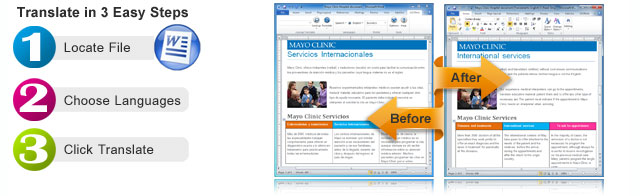
It's easy to translate your documents with the click of a key. Systran offers the most accurate Chinese translation software available in a software.
Easily translate Emails, Word, PowerPoint, Excel, Internet Explorer and Outlook!
These translation products are customizable so you can tailor the software to meet your needs, add to the dictionary, create topical glossaries and more.
Learn more about translator software.