
SYSTRAN TRANSLATION TECHNOLOGY
Overview
Translation software is also called Machine
Translation. A process that utilizes computer software
to translate text from one natural language into another. This definition
accounts for the grammatical structure of each language and uses rules
and assumptions to transfer the grammatical structure of the source
language (text to be translated) into the target language (translated
text).
Translation is anything but simple. It's not a mere substitution for each word,
but being able to know "all of the words" in a given sentence or phrase
and how one may influence the other. Human languages consist of morphology (the
way words are built up from small meaning-bearing units), syntax (sentence
structure), semantics (meaning), and countless ambiguities.
SYSTRAN's Technology
SYSTRAN was one of the first and is one of the few remaining independent Machine
Translation (MT) developers. In 2009, SYSTRAN released a redesigned translation engine that combines both statistical and rule based technology. By using a hybrid of both systems Systran once again offers the most advanced automated translator on the market. In 2010 they once again released a major advancement in machine translation technology with the Systran Training Server which actually analyzes previously translated documents to build it's own terminology dictionaries. Basically it learns how to translate text from already humanly translated documents.
SYSTRAN's R&D efforts benefit from continued development and reinvestment
in linguistics and in NLP. The goal is to prepare new generation MT systems to
improve translation quality and robustness over multi-agent, multi-threaded architecture.
Development Platforms
SYSTRAN's technology is developed under Linux and runs on all Unix platforms
and Microsoft Windows. All SYSTRAN systems utilize one engine and use the latest Natural
Language Processing (NLP) technologies. The systems integrate finite state
technology to accelerate access to very large linguistic knowledge bases. In
fact, SYSTRAN has more multilingual knowledge bases that common computers can
support. XML, Unicode and HTTP standards are central in the design to address
multilingual issues in applications such as Web, email, Intranet, publishing,
etc.
Standard
Machine Translation vs. Customized Machine Translation
Building additional dictionaries will increase
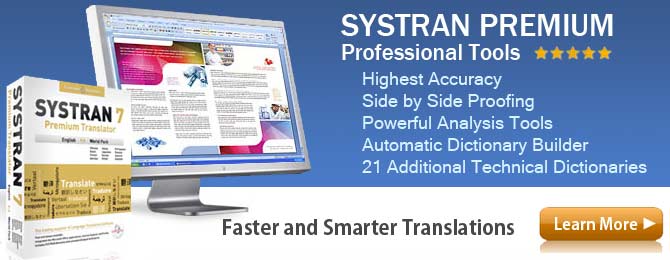
the accuracy of the translation. Systran already provides millions of additional terms in their industry specific
dictionaries, which are included in the premium version, but you can build additional dictionaries to increase the accuracy even more.
This is the real power of using translation software. You can also build a list of words
you do not want translated, for example, company names. The translation industry is changing, human translators in the future will spend more time proofing documents than actually having to translate everything manually.
| Customizing the
software can increase the accuracy of the translation
by using industry specific dictionaries, which are
included in the premium version and by building our
own customer specific dictionaries and translation memories can provide you with an impressive level of accuracy.
You can also build a list
of words you do not want translated, for example,
company names, industry specific terms. |
 |
It is important to distinguish between generic MT and customized
MT. The SYSTRAN technology powering most of the Internet
portals is a generic translation service that is based on
the largest possible dictionaries. Its aim is to provide
a "gisting level" translation
service, such as looking at a foreign page and being able
to understand the main lines of the page. The system must
obtain not only a correct syntactic analysis of the text,
but also a correct semantic analysis. This is because some
words will have different meanings and syntactic behavior,
depending on the semantic context in which they are used.
Even with the important specialized dictionaries the quality of the translation
cannot always be fully satisfactory because of the total freedom and productivity
of content on the web; the dictionaries selected cannot be the exact domain
glossary due to extreme diversity; and the impossible task of having a complete
description of all possible domains (a problem not only of cost, but of expertise).
The key point is that no generic MT system today can solve
all translation problems. Although Systran is considered
the best it will still not replace a human translator, language
is to complicated but you can increase the accuracy of the
translation the software delivers by creating your own customer
specific dictionaries and customizing the software with your
company's or industry's terminology. Systran will give you
a rough draft of the translation that can be edited further
for more accuracy. This time savings alone makes the investment
into translation software a wise choice.
|